
The Third-Party Logistics (3PL) Industry

The third-party logistics (3PL) industry plays a crucial role in the supply chain by offering outsourced logistics and supply chain management services to businesses. Companies that provide 3PL services specialise in various aspects of logistics, transportation, and distribution, allowing their clients to focus on their core competencies.
Third-Party Logistics (3PL) Industry Software
THINK’s warehouse management system software provides comprehensive functionality, scalability, and flexibility to manage multi-client operations, optimise inventory and order management, and deliver value-added services to clients while maintaining compliance and efficiency across the supply chain. All whilst allowing a highly configurable approach to the unique requirements of 3PL operations and customers. THINK has experience in working with a number of third-party logistics (3PL) companies including XPO Logistics, NFS 360 Connect and Cargo Express.
Benefits to the Third-Party Logistics (3PL) Industry
The benefits of implementing a warehouse management system within the automotive industry include:
- Improved warehouse efficiency
- Real-Time visibility
- Multi-client support
- High level of configuration to suit to needs of different clients
- Order accuracy and fulfillment
- Cross-docking efficiency
- Dynamic slotting
- Billing and invoicing accuracy
- Flexible reporting and analytics
- Scalability for business growth
- Customer visibility
- Compliance with service agreements
- Integrated supply chain management
Third-Party Logistics (3PL) customer
A Third-Party Logistics (3PL) customer appointed THINK to digitise their warehousing and stock control away from excel spreadsheets and a paper-based system. The objective was to move to an on-line warehouse management system to improve stock visibility and position the company for further growth and expansion.
Why Choose THINK?
We employ experienced WMS consultants to work with your company and assess the current warehouse operations, understand your specific needs and challenges, and then recommend, implement, and customise WMS solutions that align with the company’s goals and objectives. Our expertise covers a wide range of areas, including technology, logistics, supply chain management, process optimisation and software integration. When combined with our approach to project management, this leads to consistent achievement of objectives within agreed timescales.
From the outset our Warehouse Management System was designed to easily interface with other business applications ranging from ERP systems such as SAP, System 21, SAGE, MS Dynamics, Oracle etc. Through to Ecommerce providers such as Shopify and Prestashop.
Implementing a warehouse management system / WMS should not mean an upheaval on time or costs. THINK’s wealth of industry experience with a deep routed industry skill set means we can work with your business to provide the most intuitive WMS on the market. Get your staff trained and operational within 45 minutes – it really is that user friendly.
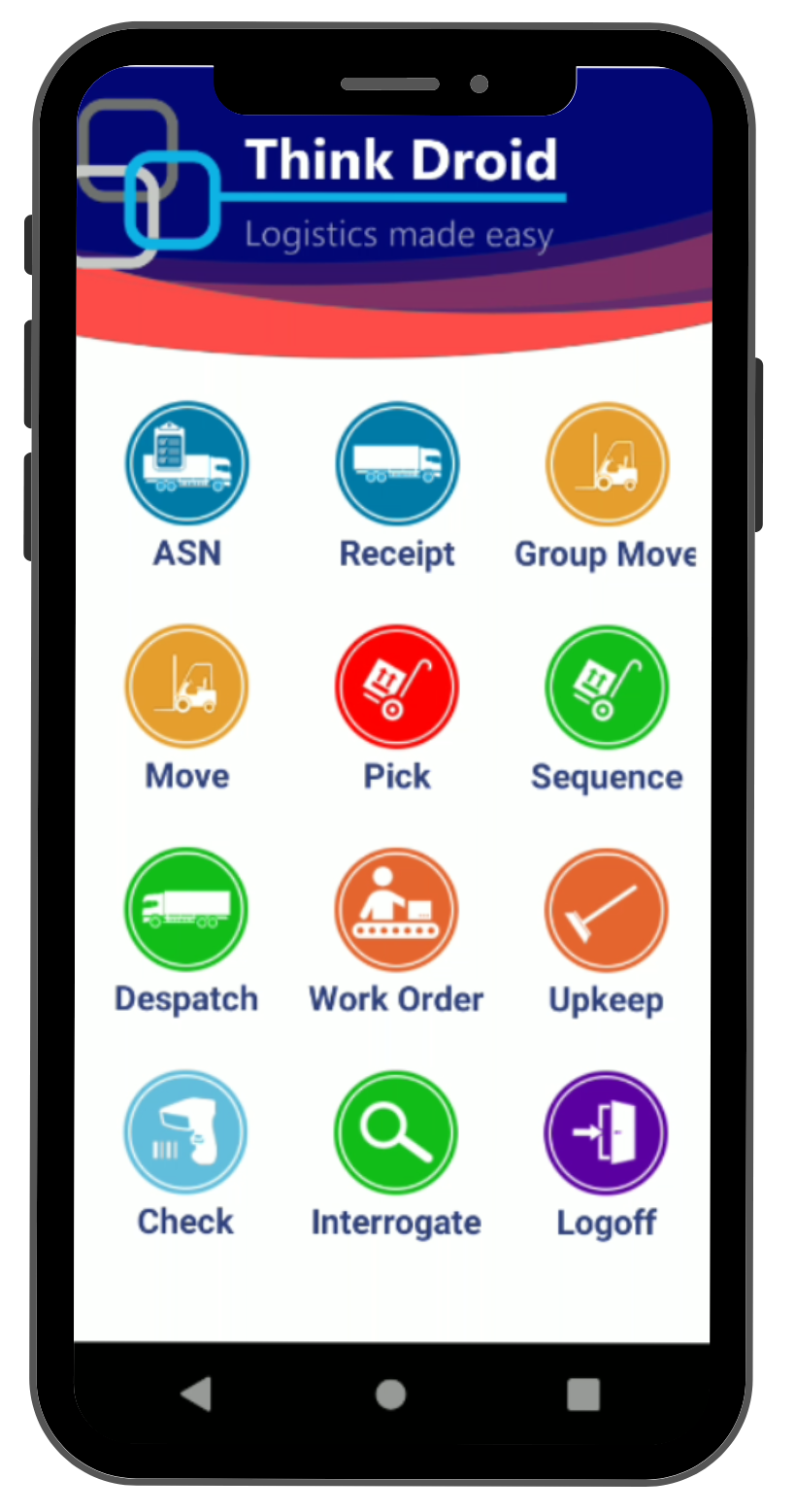
Here is an example of our system on an Android phone, showing how you can use it on the go.
Are you worried that a warehouse management solution will be too expensive, or that you will be trapped in a long contract? To arrange a demo or discuss your requirements contact THINK; give us a call on 0330 350 0715, email enquiries@tkinv.com or complete the enquiry form below. We can work with your business to help save you money and drive down costs.