

We write many blogs here at THINK, but today we’re going back to basics for anyone who needs an introduction. If you’ve ever wondered how large warehouses keep track of thousands (or even millions) of products without descending into chaos, the answer is usually a WMS which stands for Warehouse Management System. This guide breaks it down in plain English. No jargon, no assumptions, just the essentials. You may also find our Glossary of Terms useful.
What is a WMS?
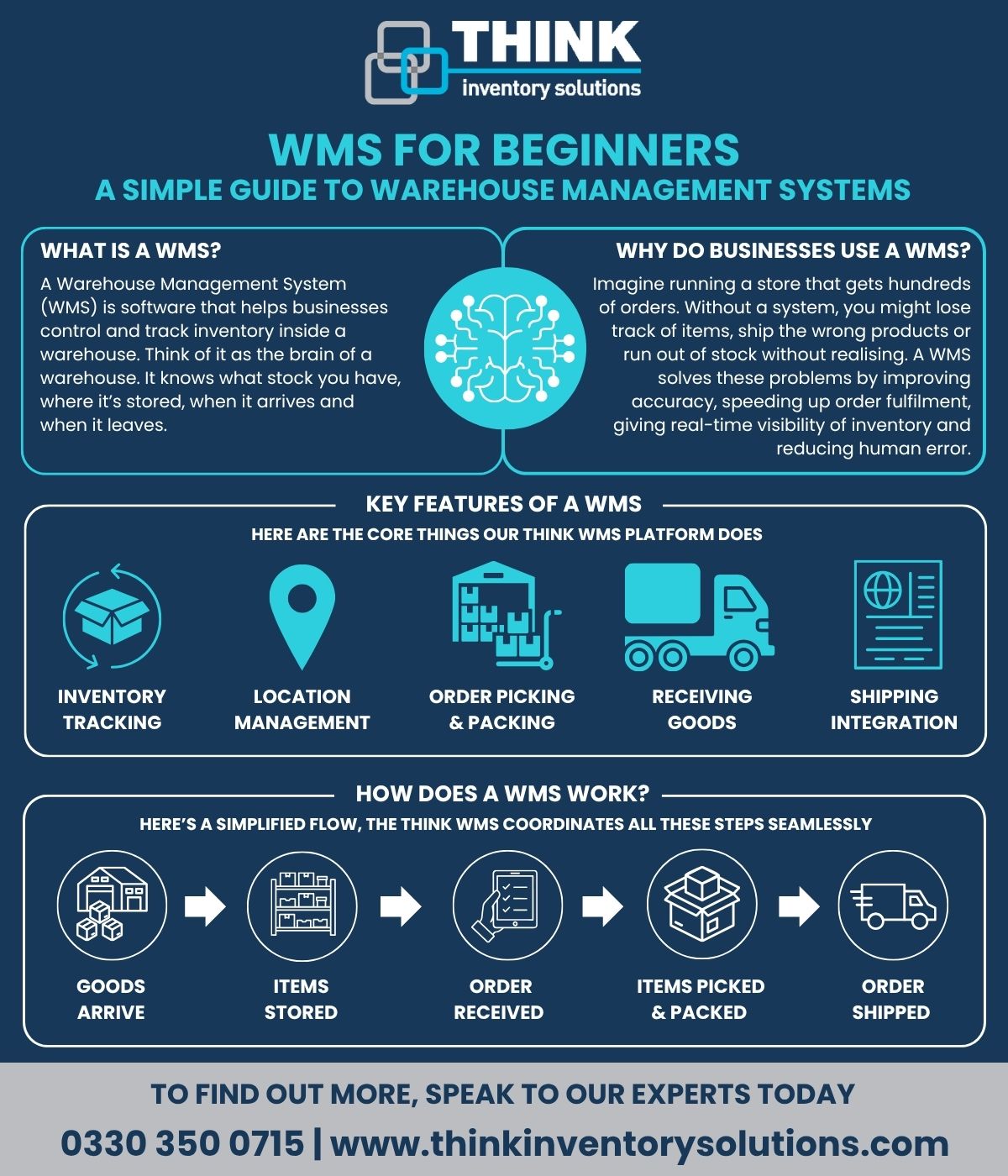
A Warehouse Management System (WMS) is software that helps businesses control and track inventory inside a warehouse. Think of it as the brain of a warehouse. It knows what stock you have, where it’s stored, when it arrives and when it leaves. Without a WMS, warehouses often rely on spreadsheets or manual processes which quickly become slow, error-prone, and difficult to scale.
Why Do Businesses Use a WMS?
Imagine running an online store that suddenly gets hundreds of orders a day. Without a system, you might lose track of items, ship the wrong products or run out of stock without realising. A WMS solves these problems by improving accuracy, speeding up order fulfilment, giving real-time visibility of inventory and reducing human error.
Key Features of a WMS
Here are the core things our THINK WMS platform does:
- Inventory Tracking: A WMS tracks every item from the moment it arrives to the moment it ships.
- Location Management: It tells you exactly where items are stored whether it be aisle, shelf or bin, etc.
- Order Picking & Packing: Guides workers on what to pick and in what order to minimise time and mistakes.
- Receiving Goods: Logs incoming shipments and updates stock levels automatically.
- Shipping Integration: Helps generate labels, track shipments, and integrate with couriers.
How Does a WMS Work?
Here’s a simplified flow, the THINK WMS coordinates all these steps seamlessly:
- Goods arrive → scanned into the system
- Items stored → assigned a specific location
- Order received → system generates picking list
- Items picked & packed → verified and prepared
- Order shipped → inventory updated in real time
Who Needs a WMS?
If you’re handling more than a small volume of orders, a WMS quickly becomes essential. A WMS is particularly useful for:
- E-commerce businesses
- Retailers with storage facilities
- Manufacturers
- Third-party logistics (3PL) providers
Common Beginner Misconceptions
“A WMS is only for huge companies.”
Not true. Many affordable cloud systems are designed for small businesses.
“It’s too complicated to implement.”
Modern systems are much more user-friendly than older ones.
“Spreadsheets are enough.”
They work until they don’t. Growth quickly exposes their limits.
Contact THINK Inventory Solutions
A Warehouse Management System might sound technical, but at its core, it’s about keeping things organised, efficient, and accurate. If your business involves storing and shipping products, adopting a WMS isn’t just a nice upgrade, it can be a game changer. Give our experts at THINK a call today on 0330 350 0715 or contact us via our Quick Quote.
Recent Comments