

If your warehouse feels chaotic and you’re experiencing lost stock, slow picking, constant double-checking etc. You’re not alone. Most small businesses hit this point when orders start increasing, stock levels get harder to track and spreadsheets stop keeping up. The good news? You can improve things dramatically in a single day. The reality? Most businesses outgrow this setup faster than they expect. This guide shows you how to organise your warehouse quickly, and when it’s time to move beyond manual systems.
What Your Small Warehouse Can Do Right Now
This will give you immediate improvements but keep in mind that this is a short-term fix, not a long-term system. We explain below how to best spend your time getting your warehouse optimised.
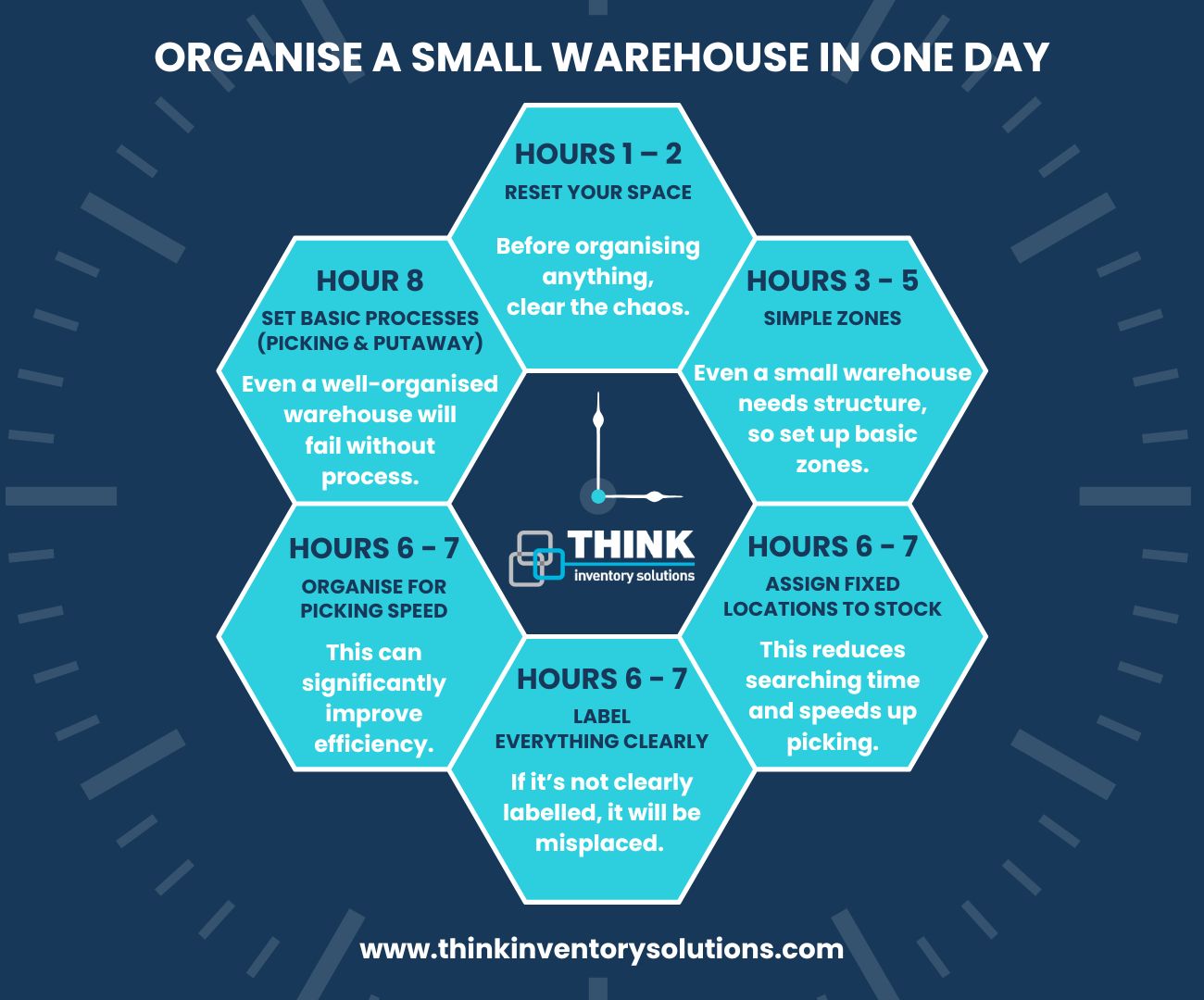
Hours 1 – 2: Reset Your Space (Declutter First)
Before organising anything, clear the chaos.
- Remove obsolete or damaged stock
- Get everything off the floor
- Group similar items together
This alone can make your warehouse feel more manageable. Decluttering doesn’t stop things from becoming disorganised again though, it just helps in the short term.
Hours 3 – 5: Create Simple Zones
Even a small warehouse needs structure, so set up the following basic zones:
- Receiving
- Storage
- Picking
- Packing/Dispatch
This will improve efficiency immediately, but as order volume grows, maintaining this flow manually becomes harder, especially with multiple people involved.
Hours 6 – 7: Assign Fixed Locations to Stock
- Give every product a “home.”
- Label shelves (A1, A2, B1 etc)
- Group similar items
- Keep fast-moving items close to packing
This reduces searching time and speeds up picking but only works well with one or two people. Once multiple pickers are involved, things start to rely heavily on memory and discipline which is where errors creep in.
Hours 6 – 7: Label Everything Clearly
If it’s not clearly labelled, it will be misplaced. Label shelves, bins and aisles and make labels large, consistent and easy to read. This relies entirely on people following the process, which becomes harder as you grow.
Hours 6 – 7: Organise for Picking Speed
Most small warehouses are set up for storage not picking. Improve this by:
- Reducing walking distance
- Creating a logical picking route
- Keeping popular items together
This can significantly improve efficiency but without a system guiding pickers, consistency becomes difficult as order volume increases.
Hour 8: Set Basic Processes (Picking & Putaway)
Even a well-organised warehouse will fail without process.
Picking:
- Pick from a list
- Follow a consistent route
- Check at packing
Putaway:
- Stock arrives
- Assigned a location
- Put away immediately
These processes will only work if everyone follows them perfectly. As your business grows, that becomes harder to maintain.
What Growing Businesses Do Next
Once manual organisation starts to struggle, businesses typically move from spreadsheets, basic layouts and manual processes to a Warehouse Management System (WMS). A WMS tracks stock in real time, directs pickers to exact locations, reduces human error and maintains consistency as you scale. If you’ve organised your warehouse and things are already starting to feel stretched again, you’re at a common turning point. Most small businesses reach a stage where better organisation isn’t enough, they need better systems. That’s when working with a specialist such as THINK Inventory Solutions makes the difference, we help growing businesses move beyond spreadsheets, implement the right level of WMS and scale operations without the chaos returning. If you want to understand what that could look like for your business, the next step is a simple conversation with our WMS experts.
Recent Comments