

What Amazon Has Changed Forever and What Small UK Businesses Should Ignore
For more than a decade, Amazon has shaped how customers think about delivery, availability and service. Whether you sell online, wholesale, or direct to consumers, your customers don’t compare you to the business down the road, they compare you to Amazon. As we begin 2026, that influence isn’t going away but here’s the uncomfortable truth for many small UK businesses.
Trying to copy Amazon is often the fastest way to damage your margins, overcomplicate your warehouse, and burn out your team. The smarter move is understanding what Amazon has permanently changed and just as importantly, what small businesses should confidently ignore. These tips will help decide whether your SME is ready for a Warehouse Management System and if so, what questions to ask when speaking to the experts at THINK.
What Amazon Has Changed Forever
- Customers Expect Accuracy, Not Excuses
Late deliveries happen. Stock issues happen. But in 2026 customers have little patience for inaccurate information. Amazon has trained buyers to expect clear stock availability, reliable delivery promises and proactive communication when something changes. For small businesses, this doesn’t mean offering next-hour delivery. It means knowing exactly what stock you have, where it is, and when it can realistically be delivered.
- Visibility Is Now a Competitive Advantage
Amazon customers can track an order from click to doorstep. That level of visibility has raised expectations across every sector. In 2026, successful small businesses offer real-time stock visibility across channels, clear order statuses and fewer “we’re just checking with the warehouse” moments.
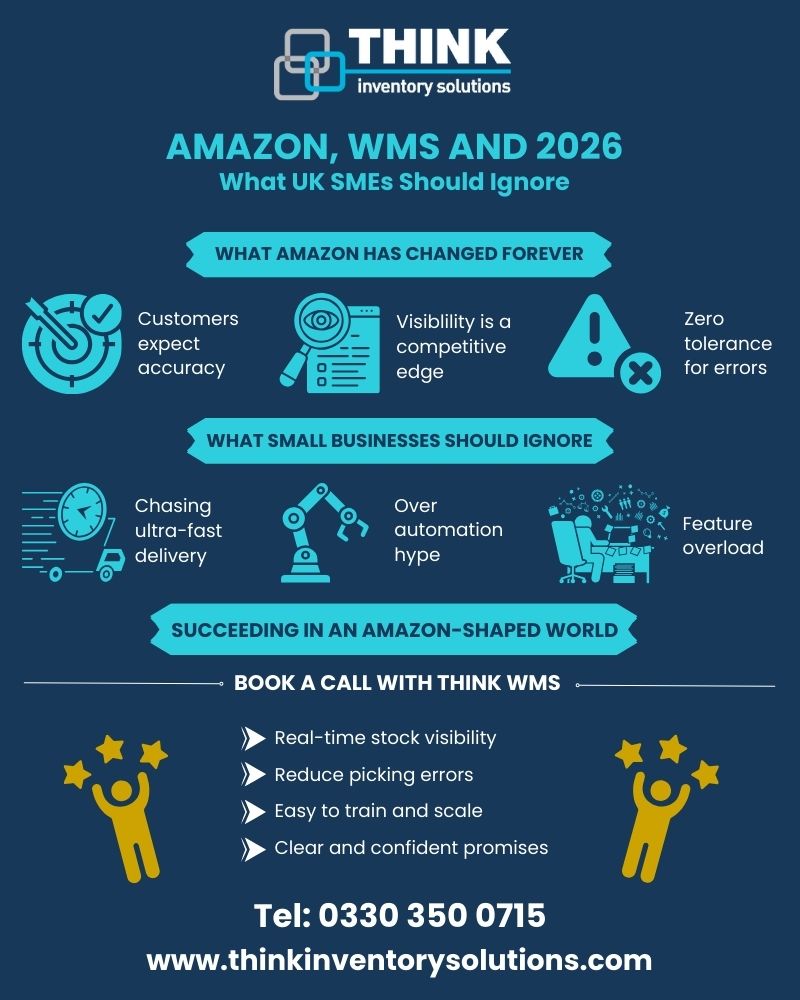
- Errors Are No Longer ‘Part of the Process’
Miss-picks and missed orders have always existed in small warehouses, but Amazon has reset the tolerance level. Every error now has a visible cost from refunds and re-shipments to negative reviews and lost repeat business.
What Small Businesses Should Ignore
- The Race to Ever-Faster Delivery
Same day delivery. Fifteen-minute delivery. One hour delivery. These models work at Amazon’s scale, not at SME margins. For most UK small businesses in 2026, customers value honest delivery times, orders arriving complete and correct and consistency over speed. Trying to compete purely on delivery speed often leads to higher courier costs, warehouse pressure and staff burnout.
- Over-Automation and ‘Warehouse Theatre’
Robots, conveyors and fully automated picking systems make great headlines but they’re rarely the right first step for a growing SME. Many small businesses gain more by improving picking accuracy, reducing wasted movement and organising stock more intelligently.
- Feature Overload
Amazon builds systems to handle almost infinite complexity. Small businesses don’t need that and paying for it can slow you down. Complex systems often result in longer implementations, poor staff adoption and expensive workarounds.
How Small Businesses Compete in an Amazon-Shaped World
The most successful UK SMEs in 2026 aren’t trying to be Amazon, they’re doing something smarter. They’re using accurate data to make confident promises, running warehouses that scale without chaos and giving customers clarity instead of speed-at-any-cost. This is where the THINK Warehouse Management System (WMS) can make the difference. A WMS built for small and growing businesses helps deliver what customers now expect without copying Amazon’s business model. Real-time stock visibility, fewer picking and packing errors, faster onboarding of new staff and clear control as order volumes grow. If you run a small business and want to compete in an Amazon-shaped world, speak to the experts at THINK to see how our WMS can help.
Recent Comments