

In 2026 automotive suppliers will be operating in a more complex environment, one where traditional petrol and diesel vehicle production runs alongside electric vehicle programmes, cross-border trade remains operationally demanding, and customer expectations continue to rise. For many suppliers, this complexity is being managed with warehouse management systems that were designed for a simpler, more standardised world. That gap between operational reality and system capability is widening and in 2026, it will be impossible to ignore. In the automotive industry, warehouse management systems need to be flexible enough to support how the industry now works. THINK has worked with prominent suppliers to the automotive and car parts industry including AMCO, International Automotive Components, Grupo Antolin and Magna, so please read on and contact us with any questions you may have.
The Changing Reality of Automotive Warehousing
UK automotive supply chains are balancing multiple pressures at once. Traditional petrol and diesel vehicle components are still required at scale, even as electric vehicle production continues to grow. These programmes have very different characteristics, from part profiles and storage requirements to velocity and lifecycle stability. Many warehouses must now support both models under one roof. At the same time, parts continue to move frequently between the UK and Europe. Even years after Brexit, cross-border movements still involve additional checks, documentation and operational oversight compared to the past. Vehicle manufacturers are also demanding more from their suppliers. Shorter delivery windows, greater traceability, and more transparency into inventory and performance are becoming standard expectations, not premium requests. The result is a UK automotive warehouse environment that is more varied, more demanding and less predictable than ever before.
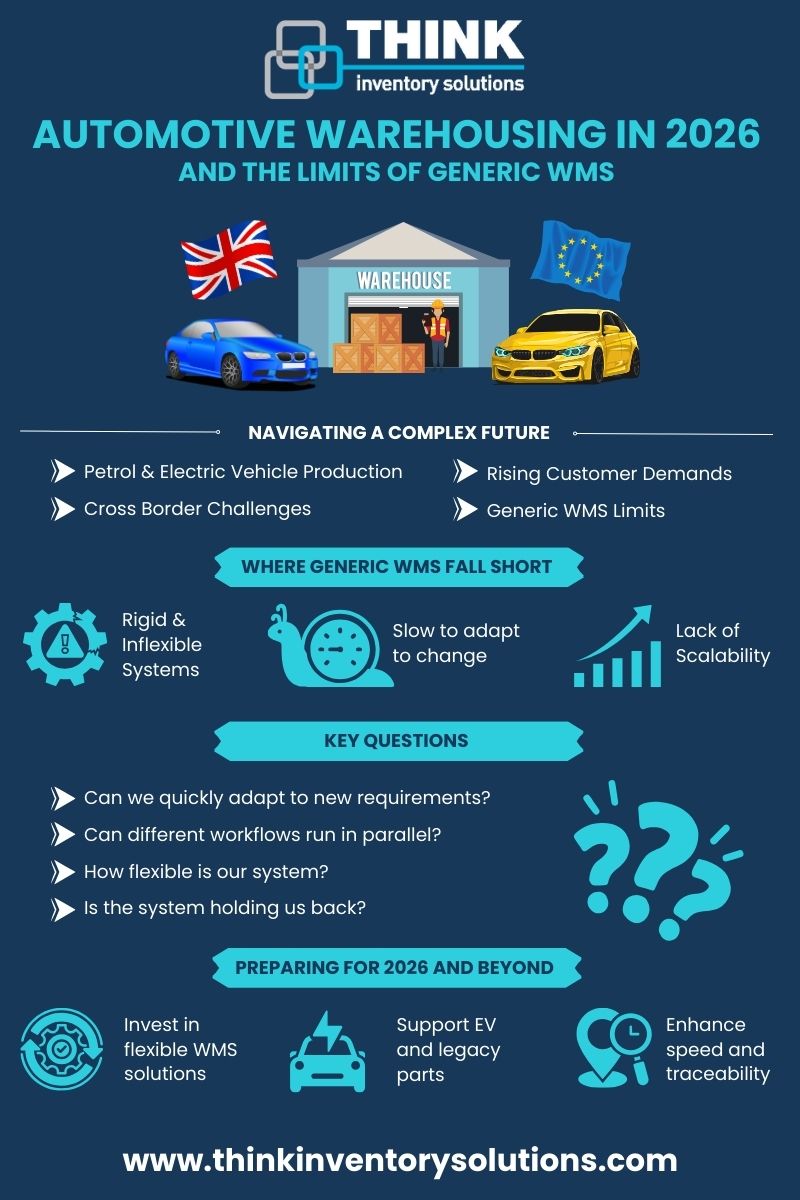
Where Generic WMS Platforms Fall Short
One of the defining characteristics of the UK automotive sector is its diversity. A Tier 1 supplier will have very different warehouse requirements to a Tier 2 supplier. Labour availability and skills also vary significantly by region. Generic warehouse management systems tend to perform well in stable, predictable environments. The challenge for UK automotive suppliers is that stability is no longer guaranteed. As electric vehicle programmes ramp up or change direction, warehouse processes must adapt quickly. As customer requirements evolve, systems need to support new workflows without months of redevelopment. As volumes fluctuate, operations must scale without breaking existing processes. Many one-size-fits-all WMS platforms struggle at this point and in 2026, these limitations will change from being an inconvenience to a competitive disadvantage.
Questions Automotive Suppliers Should Ask About Their WMS
As 2026 begins, automotive suppliers should be challenging their current approach to warehouse management systems. Ask yourself these questions and then speak to the automotive industry experts at THINK to see how our WMS compares.
- How quickly can the system adapt to a new vehicle manufacturer requirement?
- Can different customer processes run in parallel without introducing manual workarounds?
- How much flexibility exists within configuration, rather than custom development?
- Is the warehouse management system enabling operational design or forcing compromise?
These are not just technology questions. They are questions about resilience, customer confidence and long-term competitiveness.
Preparing Automotive Warehouses for 2026 and Beyond
The UK automotive sector is entering a phase where adaptability matters as much as efficiency. Warehouses must support electric vehicle growth without destabilising existing operations. They must manage ongoing trade complexity while meeting increasingly demanding service expectations. One-size-fits-all warehouse management systems will continue to function, but they will struggle to keep pace with the realities of automotive logistics.
Suppliers that invest now in flexible, configurable warehouse management systems will be better positioned to support electric vehicle programmes, respond to customer change, and compete confidently in the years ahead. The THINK WMS began in the automotive industry, so who better than us to discuss your query. We look forward to speaking with you.
Recent Comments