

If you work in an automotive parts warehouse, you’ll probably recognise the situation.
- The office receives an order
- The customer wants it quickly
- The sales team wants it picked and dispatched immediately
- Accounts want the stock figures to be accurate
- Management want to know why something is showing as out of stock
- Then someone walks into the warehouse and asks “Can you just check where that part is?”
For a warehouse manager, those eight words can sometimes mean a lot more work than the person in the office realises. Automotive parts warehouses are fast-moving, detail-heavy environments where one incorrect part, one missing item or one stock discrepancy can cause problems far beyond the warehouse. So, what do automotive warehouse managers really wish their office colleagues understood?
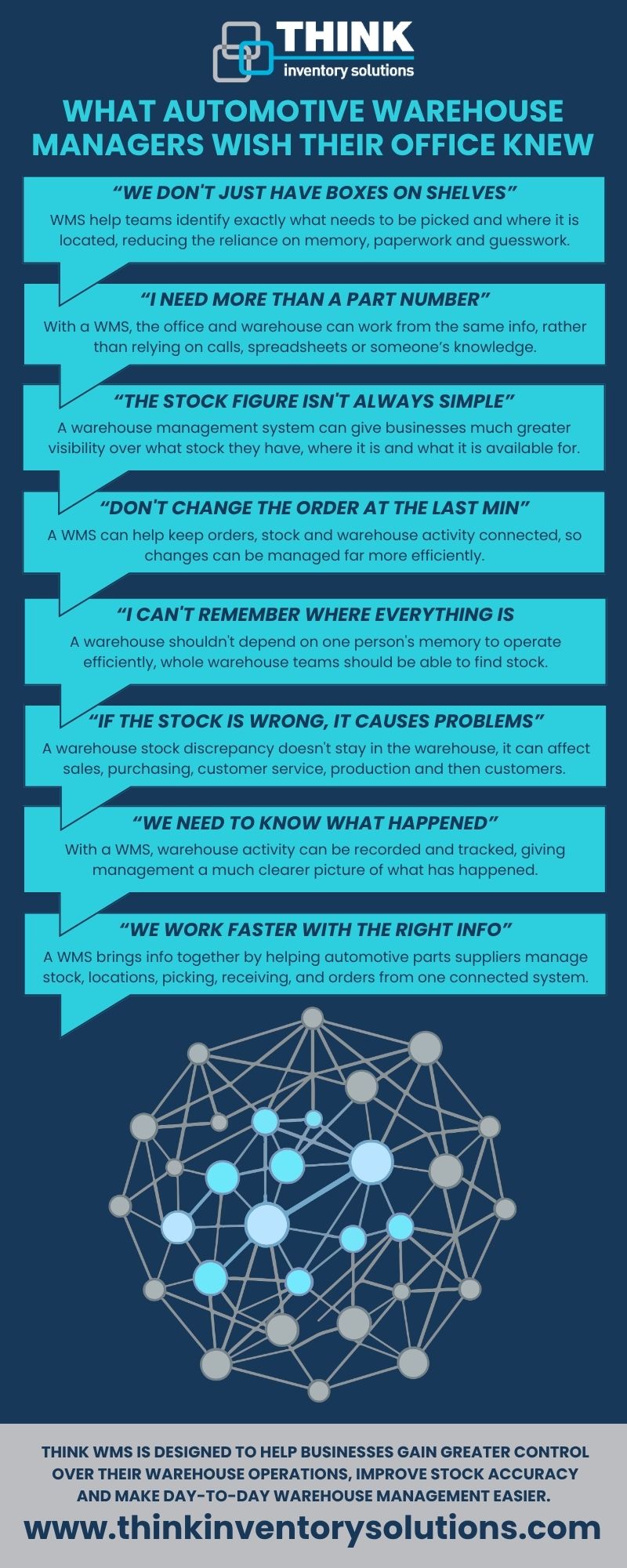
1. “We don’t just have boxes on shelves”
From the office, a warehouse can sometimes look deceptively simple. There are shelves, there are boxes and there are parts, but behind those boxes could be thousands of individual SKUs, different locations, stock levels, customer orders, returns and replenishment requirements. Plus coupled with the fact that automotive parts aren’t always easy to distinguish, two parts can look almost identical but have completely different part numbers and applications. Picking isn’t simply a case of grabbing something that looks right; accuracy matters. The THINK WMS helps warehouse teams identify exactly what needs to be picked and where it is located, reducing the reliance on memory, paperwork and guesswork.
2. “When you ask where something is, I need more than a part number”
An office might see “part number: ABC123” but a warehouse manager might be thinking:
- Which product?
- Which variant?
- Which location?
- How many are available?
- Is the stock available?
- Is some already allocated to another order?
- Has it recently been moved?
- Has it been booked in correctly?
This is why having accurate, real-time warehouse information is so important. With a WMS, the office and warehouse can work from the same information, rather than relying on phone calls, spreadsheets or someone remembering where an item was put.
3. “The stock figure isn’t always as simple as it looks”
The office might see that the system says there are 25 units in stock, but the warehouse could know that:
- 10 are already allocated to customer orders
- 5 are damaged
- 3 are awaiting inspection
- 2 are in the wrong location
- 5 are genuinely available
Suddenly, those 25 units aren’t really 25 units available for sale. A warehouse management system can give businesses much greater visibility over what stock they have, where it is and what it is available for. That means fewer awkward conversations between the office and warehouse, and of course, fewer disappointed customers.
4. “Please don’t change the order at the last minute”
Of course things change; customers change quantities, orders are amended and urgent requirements appear, that’s just part of working in the automotive supply chain, but every change has a knock-on effect. If an order has already been picked, changing it means someone may have to find the items again, amend the paperwork, change the picking instructions and make sure the correct parts are eventually dispatched. The more manual the process, the greater the opportunity for something to be missed. A WMS can help keep orders, stock and warehouse activity connected, so changes can be managed far more efficiently.
5. “I can’t remember where everything is”
We covered this last month, but every warehouse seems to have that one person, the person who has worked there for years. Ask them where a particular part is and they’ll say, “aisle 7, third bay down, top shelf” and magically, they’re right every time. However, what happens when they’re on holiday, off sick or maybe even leave the business? A warehouse shouldn’t depend on one person’s memory to operate efficiently. This is where a WMS really bridges that knowledge gap by recording product and location information digitally and allowing warehouse teams to find stock without relying on a single employee.
6. “If the stock is wrong, it causes problems everywhere”
A warehouse stock discrepancy doesn’t necessarily stay in the warehouse, it can affect sales, purchasing, customer service, production and then customers. If the system says you have a part when you don’t, the sales team could promise it to a customer. If the system says you’re out of stock when you have 50 units sitting on a shelf, you could unnecessarily place another order with a supplier, both scenarios cost money. Accurate stock control isn’t just a warehouse issue; it’s a business issue.
7. “We need to know what happened, not just what should have happened”
When something goes wrong, one of the first questions is usually “what happened?”. They want to know who picked it, when it was picked, where was the stock located, how many were available, was the order changed and was the stock received correctly? With a WMS, warehouse activity can be recorded and tracked, giving management a much clearer picture of what has happened. Instead of trying to reconstruct events from paperwork, spreadsheets and conversations, you have a digital record of warehouse activity.
8. “Give us the right information and we can work much faster”
Ultimately, warehouse managers aren’t trying to make life difficult for the office, they want the same thing as everyone else which is the right parts, in the right quantities, going to the right customer, at the right time. The problem is that achieving that becomes much harder when information is spread across spreadsheets, paperwork, emails and people’s memories. A Warehouse Management System brings that information together by helping automotive parts suppliers manage stock, locations, picking, receiving, orders and warehouse activity from one connected system.
Could Your Automotive Warehouse Work Smarter?
If your warehouse still relies heavily on spreadsheets, paperwork, manual stock checks or employees who know where everything is, it may be time to look at what a Warehouse Management System could do for your business. THINK WMS is designed to help businesses gain greater control over their warehouse operations, improve stock accuracy and make day-to-day warehouse management easier. Because your warehouse manager shouldn’t have to spend half the day explaining to the office where the stock is, the system should already know. Contact THINK Inventory Solutions about how a Warehouse Management System could help.
Recent Comments